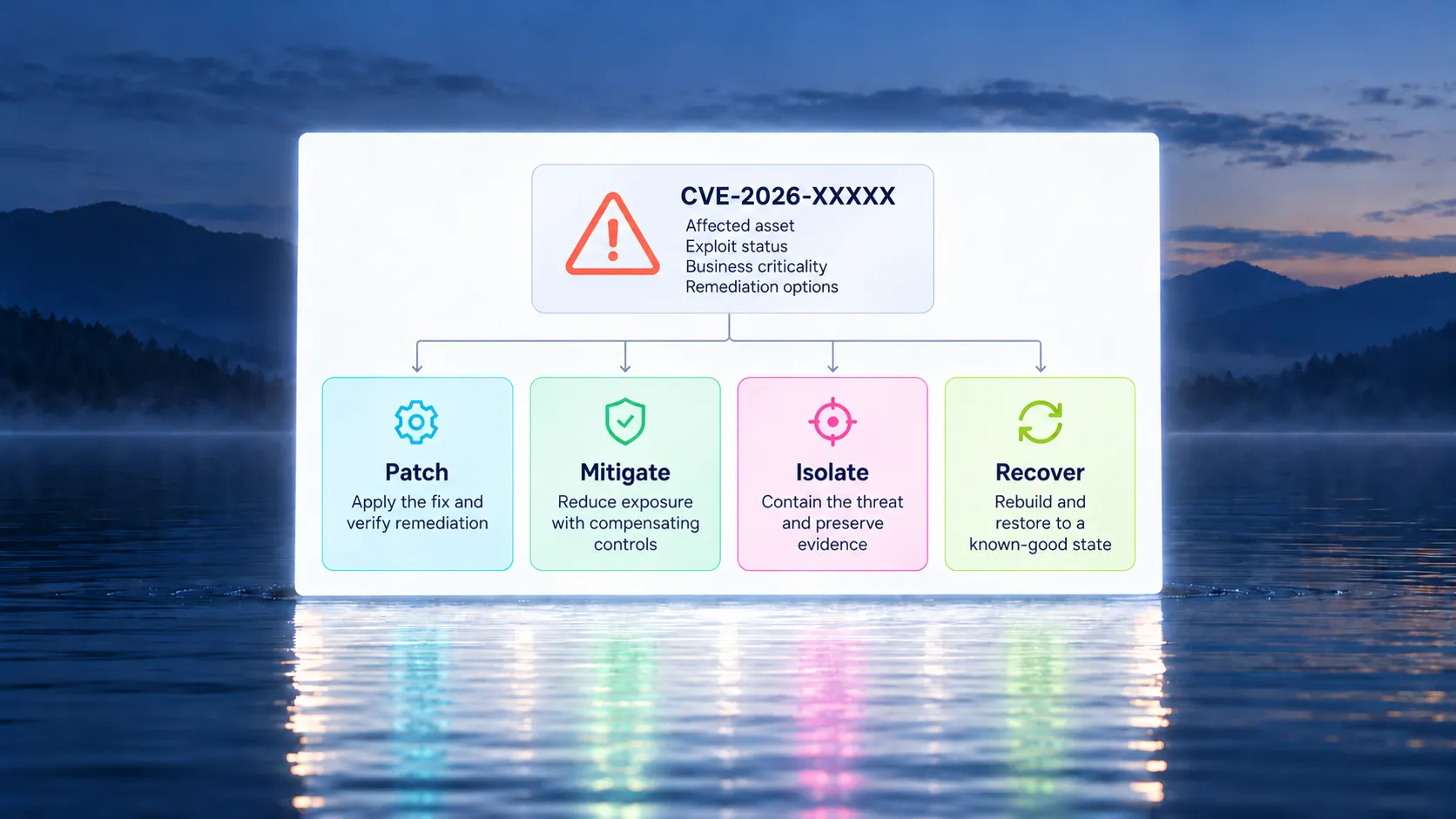


Exposure validation checks whether a suspected weakness matters under defined conditions in your environment. Its useful output is a better-supported remediation decision: act sooner, change the affected scope, select a temporary control, or investigate an unresolved question. A test that fails to demonstrate exploitation does not, by itself, establish that an asset is safe.
The difficult moment comes when a finding meets contradictory evidence. Inventory says the vulnerable component is present. An external test cannot reach it. A service owner wants the ticket closed. Security still sees a credible route from an internal network.
Calling the exposure validated or unvalidated does little to resolve that disagreement. The team needs to know which claim the evidence supports, which conditions it covers, and what action should change as a result.
Start with the decision the evidence could change
Before collecting more evidence, identify the pending decision. Are you deciding whether the finding applies, whether to accelerate a fix, or whether a temporary control is sufficient until a planned change?
Those questions need different answers. A component inventory can establish applicability. A reachability check can inform a particular access route. Neither automatically establishes the business consequence of exploitation.
For the wider program context, see the distinction between exposure management and vulnerability management. Here, the narrower task is deciding how much weight to give a specific observation.
We recommend writing the decision as a sentence before reviewing the result:
“Can the internet-facing instances remain in the routine patch window, given the currently observed access controls?”
That sentence is more useful than “Is this vulnerability exploitable?” It identifies the asset group, the timing decision, and the assumption that needs evidence. It also prevents a result from being applied to unrelated systems simply because they share a CVE identifier.
Keep predictions, observations, and decisions separate
Threat intelligence can tell you where to look. Local evidence helps explain what is present and reachable. The decision still needs an owner who understands the consequences.
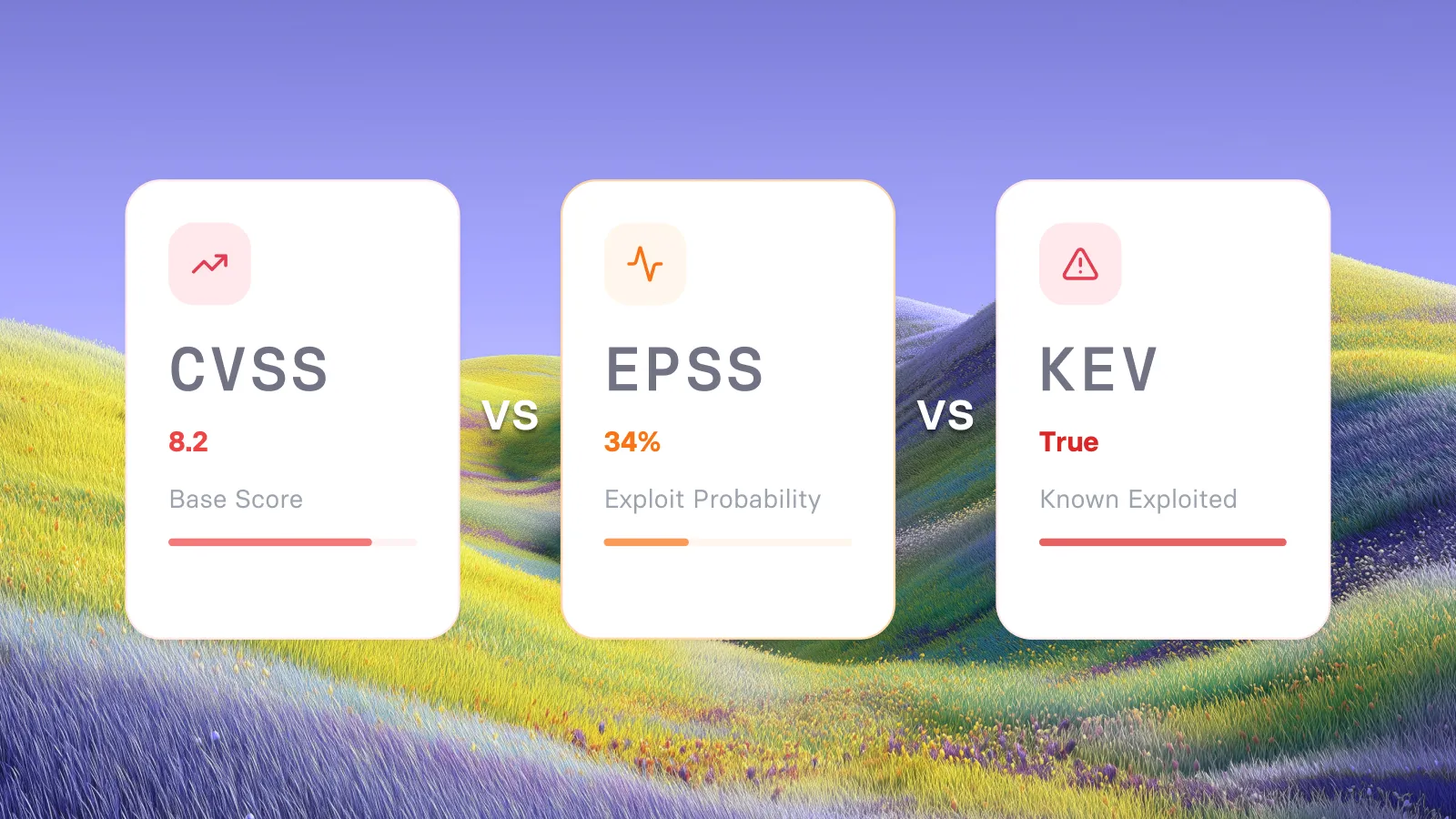
The Exploit Prediction Scoring System, or EPSS, estimates the probability of exploitation activity in the wild over the next 30 days. FIRST explicitly distinguishes that forecast from a complete risk assessment: EPSS does not establish whether a particular organization is affected or account for its compensating controls. FIRST EPSS FAQ.
A prediction therefore cannot substitute for a local observation. Equally, a local observation should not erase a relevant threat signal without an explanation.
NIST SP 800-115 distinguishes testing viewpoints and describes the limits of individual assessment techniques. It supports combining examination and testing rather than treating one method as a complete picture. Its assessment-planning guidance also calls for agreed scope, authorization, and boundaries. NIST technical testing guide.
Our recommendation is to keep separate fields for what is suspected, what was observed, and what the team decided. Otherwise, a label such as low risk can conceal an unresolved test failure.
What should each result allow you to conclude?
Use the following matrix as a decision aid. It is an editorial recommendation, not a standardized scoring system. Apply it alongside your organization's remediation obligations and risk policy.
| Evidence available | Bounded conclusion | Recommended response |
|---|---|---|
| Current inventory and vendor applicability information establish that the affected component is absent | This specific finding does not apply to the checked asset state | Resolve the applicability question and retain the evidence; reassess if the component is introduced |
| An authorized test demonstrates the relevant behavior on an affected asset | The tested route works under the recorded conditions | Reassess urgency and affected scope; select a correction or suitable interim control |
| A relevant control demonstrably blocks the tested route | That route is constrained while those conditions hold | Assess remaining routes and preserve the permanent-fix plan; make any timing exception explicit |
| A test produces no effect, but its coverage or prerequisites are uncertain | The result is inconclusive | Investigate the uncertainty; do not lower priority solely because the attempt failed |
| A previous result depends on a configuration or access path that has changed | The old conclusion needs review | Refresh the evidence before relying on it to defer remediation |
The important distinction is between evidence that disproves applicability and evidence that constrains one route. If the vulnerable component remains installed, a blocked path may justify a different response schedule. It does not describe the same state as removing the vulnerability.
Avoid recording both outcomes as fixed. That would make a later control change difficult to interpret: did the exposure return, or was it never removed?
Treat inconclusive results as work to resolve
A useful negative result has an explanation. A vague failure message does not tell the remediation owner whether a control intervened, the target was wrong, or the test never reached the relevant condition.
Ask for the smallest piece of evidence that would resolve the uncertainty. That could be the applicable vendor advisory, an authenticated inventory record, a control event, or confirmation of the tested network path. More intrusive testing is not automatically the best next step.
Where active testing is necessary, use an approved assessment plan with defined targets, permitted activity, and escalation contacts. NIST's guidance treats planning and authorization as prerequisites and warns that intrusive testing introduces operational risk. NIST SP 800-115.
We recommend keeping the remediation owner and due date in place while a test result is unresolved. Changing the evidence status to inconclusive should not quietly remove the work from the queue.
This also gives automation a clearer boundary. A workflow can route missing evidence for review without converting missing evidence into permission to close a finding.
A blocked external route does not settle an internal exposure
Consider a hypothetical application cluster with a vulnerable component. An authorized check from outside the organization cannot reach the affected service because an access rule blocks that path. The same service remains reachable from a support network.
The external result answers a narrow question: the tested external route was unavailable under the observed configuration. It does not establish whether the support-network route is safe.
The response should reflect that difference. The team could retain the patch plan, inspect the support-network access, and assess whether an additional temporary restriction is appropriate. If it changes the patch deadline, the decision record should name the condition supporting that change and the person accountable for it.
Now suppose the application is moved behind a different gateway. The earlier result may still be historically accurate, but the deployment has changed. The team should review the deferral rather than copying the old result into the new asset record.
Nothing in this example requires a universal risk multiplier or a fabricated confidence percentage. The reasoning is visible: a particular observation supports a particular decision for a particular set of conditions.
Give evidence a review trigger
We recommend treating evidence validity as conditional. Record which changes would make the conclusion unsafe to reuse, rather than relying only on a calendar reminder.
Relevant triggers might include a new network route, a changed privilege assignment, a disabled control, a revised vendor advisory, or a different application deployment. Choose triggers that match the actual reason for the decision.
An exception based on segmentation needs review when segmentation changes. An applicability decision based on an absent component needs review when that component is installed. A test using one access level should not be silently generalized to a newly privileged account.
Keep the record short enough to use:
• The affected asset group and the decision being made.
• The observation, its source, and when it was collected.
• The conditions and limitations that matter to the conclusion.
• The selected action, accountable owner, and review trigger.
This record supports judgment; it should not become a manual approval form for every routine correction. Where an approved policy already covers an applicable fix, avoid adding a separate exploit-demonstration requirement unless the decision genuinely depends on it.
Measure the decision, not the number of tests
A count of completed validations says little about what changed. For program reporting, we recommend tracking whether evidence led to an accelerated correction, a narrower applicability scope, a temporary-control decision, or an unresolved investigation.
Keep the last category visible. Otherwise, a dashboard can look healthier simply because uncertain findings stopped appearing in the remediation queue.
Also distinguish a justified deferral from a completed fix. Both can be legitimate outcomes, but they carry different follow-up work. Leadership should be able to see which exposures were corrected and which still depend on controls or accepted conditions.
Frequently asked questions
Is exposure validation the same as vulnerability scanning?
No. Scanning identifies potential weaknesses; exposure validation evaluates evidence relevant to a particular exposure and decision. It may use inventory, configuration review, threat information, or authorized testing. The useful question is whether the evidence supports the conclusion being drawn, not which tool produced it.
Does an unsuccessful exploitation attempt justify delaying a patch?
Not by itself. First establish whether the attempt covered the relevant conditions and why it failed. Our recommendation is to change timing only through an explicit risk decision that accounts for remaining uncertainty, applicable obligations, and any controls supporting the delay.
Can EPSS prove that a particular asset is exploitable?
No. EPSS forecasts exploitation activity in the wild over a 30-day horizon. It does not inspect your asset or establish its local configuration, reachability, or business impact. Those require separate evidence. FIRST EPSS FAQ.
How often should exposure-validation evidence be refreshed?
Use a review interval appropriate to the decision and refresh it when a supporting assumption changes. We recommend event-driven review for changes to relevant access, controls, components, and deployment state. There is no universal interval proposed by this framework.
Apply the matrix to one pending decision
Choose one finding whose remediation timing depends on a validation result. Write down what the result establishes, what remains uncertain, and which change would invalidate the conclusion. Then confirm that the selected action has an owner. If the evidence cannot support the timing decision, keep the remediation work open while resolving the gap.