

An EPSS threshold can create a queue faster than a team can clear it. Before adopting one, test what it selects, how much remediation work follows and what evidence justifies the vulnerabilities it leaves behind.
Choose an EPSS score threshold by comparing candidate cutoffs against a dated vulnerability inventory, available remediation capacity and observed exploitation evidence. Keep urgent overrides separate. A threshold is a policy choice, not a universal boundary between safe and dangerous vulnerabilities.
The useful output is a defensible decision: this cutoff produces this amount of work, under these assumptions, with these remaining limitations. That is more informative than labeling a score “high” without explaining what the label changes.
What does an EPSS score measure?
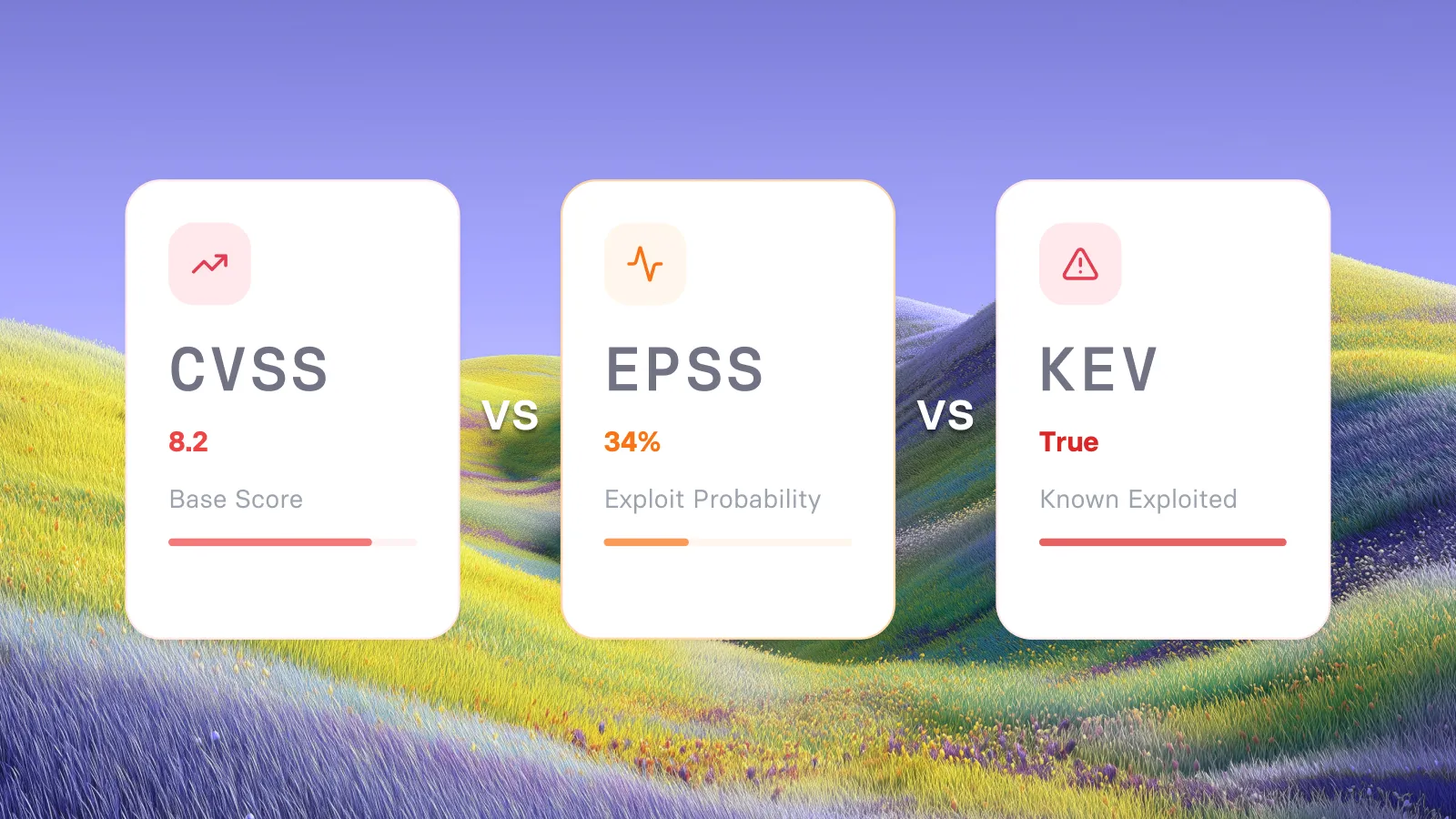
The Exploit Prediction Scoring System, maintained through FIRST’s EPSS community, estimates the probability of observed exploitation activity for a CVE over the next 30 days. It is an input to prioritization, not a complete assessment of an organization’s risk. FIRST’s EPSS overview.
Probability and percentile answer different questions. Probability expresses the forecast; percentile describes relative position among scored vulnerabilities. A high percentile does not mean the same numerical probability. FIRST also states that there is no universal threshold, and that the often-cited 0.10 cutoff has no special authority from EPSS. FIRST’s EPSS FAQ.
Use an explicit field in your policy: “EPSS probability at least 0.10,” for example. This wording is a candidate rule to evaluate, not our recommendation to adopt that number. It prevents a probability cutoff from being confused with a percentile cutoff during implementation.
Define the decision before measuring the threshold
Start by deciding what crossing the threshold means. It could mean entering a review queue, receiving an accelerated remediation deadline or becoming eligible for a defined deployment policy. Those are different decisions and require different evidence.
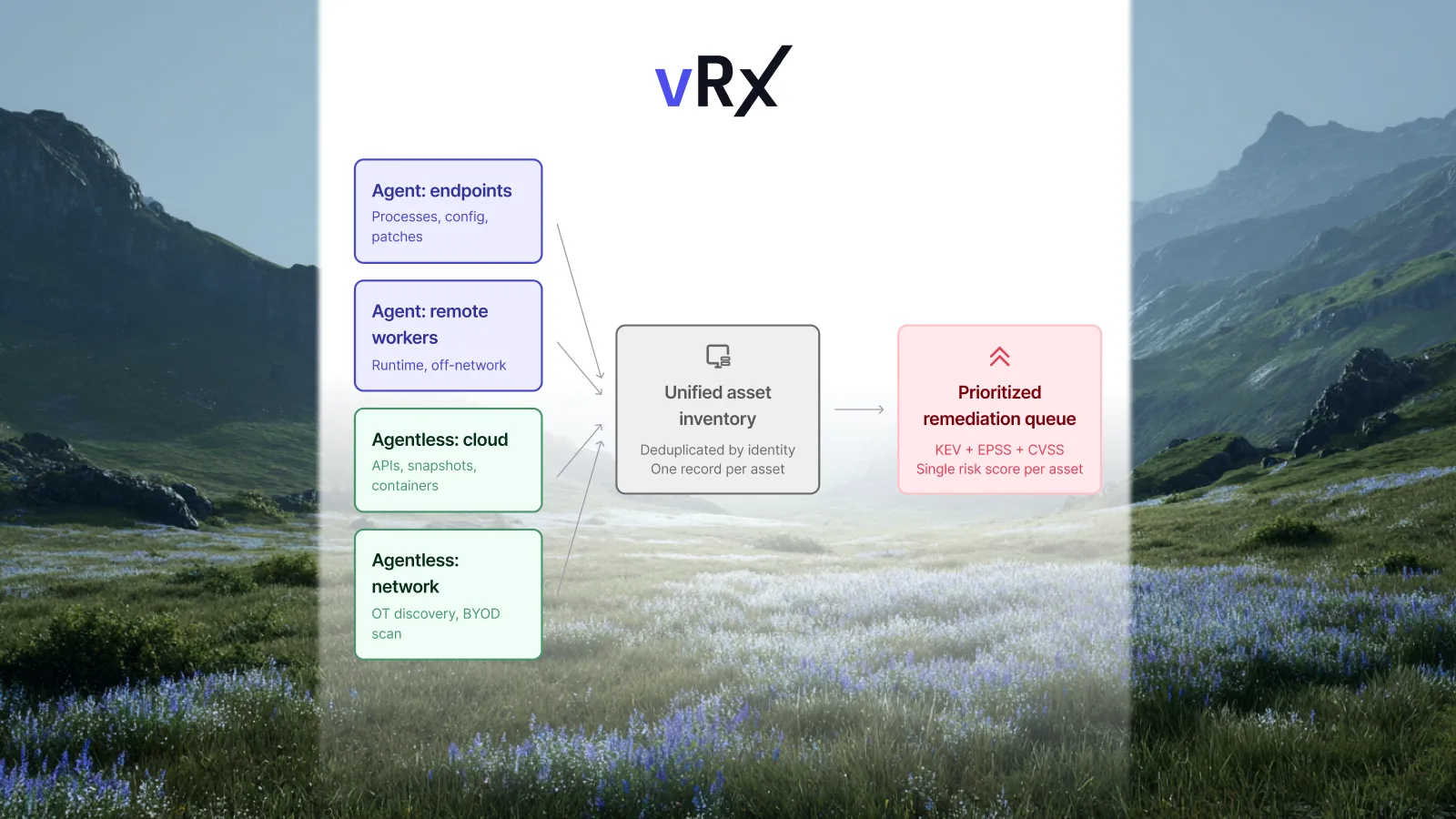
We recommend evaluating selection separately from execution. First identify which CVEs the candidate cutoff selects. Then translate that set into affected assets, software changes and deployment groups. Finally, assess whether the proposed work can be completed within the intended window.
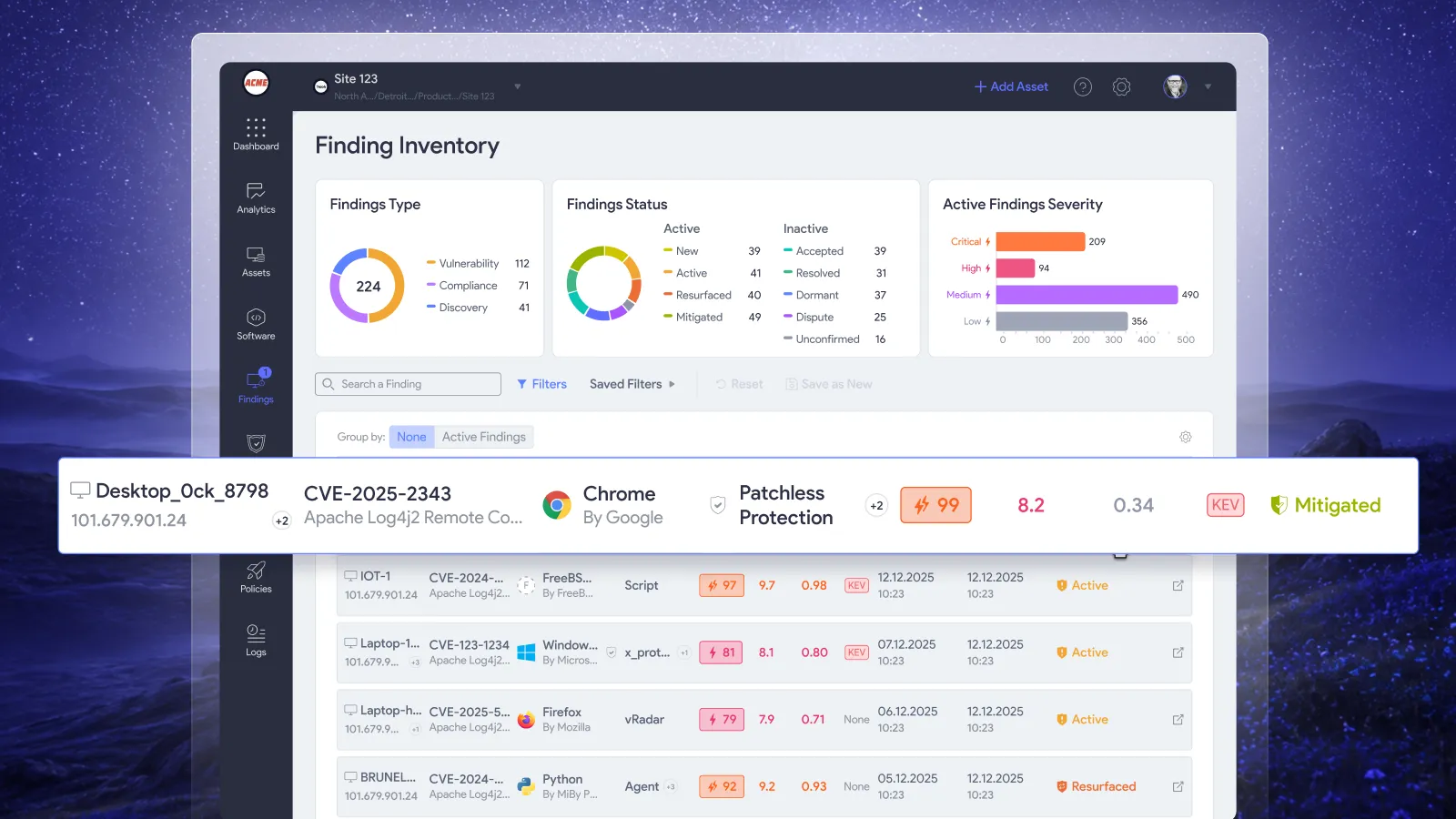
A CVE count alone is a poor workload unit. In a hypothetical inventory, one selected CVE may affect a single test machine while another affects hundreds of production endpoints. Conversely, one software upgrade may address several selected CVEs. Counting those CVEs as separate patch jobs would overstate the work.
Keep the counts alongside each other. The security lead needs to see selection coverage; the operations lead needs to see executable changes. Neither should have to reconstruct the other’s denominator from a chart.
A worked example: three cutoffs, three different queues
The following figures are entirely illustrative. They are not EPSS benchmark results, a customer outcome or measurements from a current vulnerability dataset.
Assume a frozen inventory contains 100 distinct CVEs. During the following 30 days, the chosen observation source records exploitation activity for 10 of them. Three candidate probability thresholds select nested subsets from that original inventory.
| Candidate threshold | CVEs selected | Selected CVEs with observed exploitation | Share of observed set selected | Observed exploitation among selected CVEs |
|---|---|---|---|---|
| At least 0.01 | 40 | 9 | 9/10 = 90% | 9/40 = 22.5% |
| At least 0.05 | 20 | 8 | 8/10 = 80% | 8/20 = 40% |
| At least 0.10 | 10 | 6 | 6/10 = 60% | 6/10 = 60% |
In this example, raising the threshold reduces selection from 40 CVEs to 10. The selected set contains a higher proportion of CVEs with observed exploitation, but it captures fewer of the 10 observed CVEs overall.
That tradeoff does not identify a winner. The table says nothing about affected-asset counts, business impact, available fixes or deployment capacity. It also does not prove that the remaining CVEs were never exploited; it reports what the specified observation source recorded during the specified window.
FIRST’s usage guidance discusses coverage, effort and efficiency as ways to assess prioritization. Our example applies that distinction to a small synthetic inventory so the denominators remain visible. Using EPSS.
Translate the selected set into remediation capacity
Add an operational view before approving a cutoff. For each candidate, group the selected CVEs by the changes that would address them. Record affected assets, the responsible team and the applicable deployment window.
Suppose the middle cutoff in the example produces six deployable software changes and two cases requiring investigation. That is still an illustrative assumption. It gives the operations team a concrete workload to assess, whereas “20 CVEs” leaves the execution effort unclear.
Record whether routine work can follow an existing automated deployment policy. Count exception handling separately. A policy that reduces analyst triage but creates an unmanageable exception queue has moved the bottleneck rather than resolved it.
Use completed work to estimate capacity. Planned capacity can be a useful starting assumption, but it should be labeled as such until the team has observed delivery. Include validation effort in the estimate; deployment alone is not the intended endpoint.
How to run a useful historical test
The following is our recommended evaluation design. It tests a threshold policy against retained evidence; it is not a claim that the example above has been tested.
1. Freeze the decision date. Save the inventory and the scores available on that date. Record the scoring model version when available.
2. Define the outcome window. Specify the following 30 days and the source used to identify observed exploitation. Document gaps in that source.
3. Apply candidate rules without future information. Do not use today’s score to claim what a team would have selected months ago.
4. Keep units consistent. Evaluate CVE selection at CVE level. Report asset exposure and remediation changes separately.
5. Choose on earlier periods, evaluate on later periods. Keep at least one later period out of threshold selection so it provides a less biased check.
6. Report overrides and execution outcomes. Show what the threshold selected, what other rules added, what was remediated and what remained open.
If historical scores or dependable observation labels are missing, begin with a prospective trial. Save today’s input, record the decision, then evaluate the defined outcome window when it has elapsed. Until then, report a workload simulation, not a validated prediction result.
A retrospective test can also become misleading when the inventory changes. Retain removed assets and remediated findings in the evaluation record rather than silently deleting them from the original cohort. Otherwise the denominator changes while the result appears to improve.
Keep urgent overrides explicit
A threshold should not veto evidence that requires action. We recommend an override path for confirmed relevant exploitation, urgent vendor instructions and locally critical exposure. Define who can authorize that path and record why it was used.
Evaluate the combined policy and the threshold alone. If an override adds a CVE that the cutoff missed, the resulting coverage belongs to the combined policy. Giving the threshold credit for that selection would hide the value of the override.
Review the cutoff on a defined schedule and after material changes in capacity or inventory. Preserve each policy version and its effective date. That makes later comparisons possible without rewriting what the team knew at the time.
For the broader reasoning behind revisiting priorities as evidence changes, see time-aware vulnerability prioritization. The threshold test here addresses a narrower question: which cutoff produces a defensible and executable queue?
Frequently asked questions
What is a good EPSS threshold?
There is no universally correct cutoff. FIRST recommends considering remediation capacity, risk tolerance and asset context. Test candidate thresholds before adopting one. EPSS threshold guidance.
Does a low EPSS score mean we can ignore a vulnerability?
No. EPSS does not incorporate all local consequences or control conditions. Use it alongside the evidence relevant to the affected environment, with explicit urgent overrides. What EPSS does and does not measure.
Can we backtest using today’s scores?
Today’s scores cannot establish what a historical decision would have selected. Use the scores available at the decision date. If you cannot recover them, label the exercise as a current workload simulation.
What if we cannot obtain exploitation outcome data?
You can still measure selected CVEs, affected assets and remediation workload. You cannot claim measured exploitation coverage without an appropriate outcome source. Keep those two evaluations separate.
Test one queue before changing the policy
Choose a dated inventory and compare three candidate cutoffs using the table above. Add the actual deployment groups, expected exceptions and responsible owners. Approve the rule only when its workload and remaining uncertainty are clear enough to defend.